#29 WeRemoto: a side project exit in 2 months… from LATAM
In this interview, Gastón Levy tells us what it’s like to build and sell a side project from LATAM, and how to hack an investment round through bootstrapping.
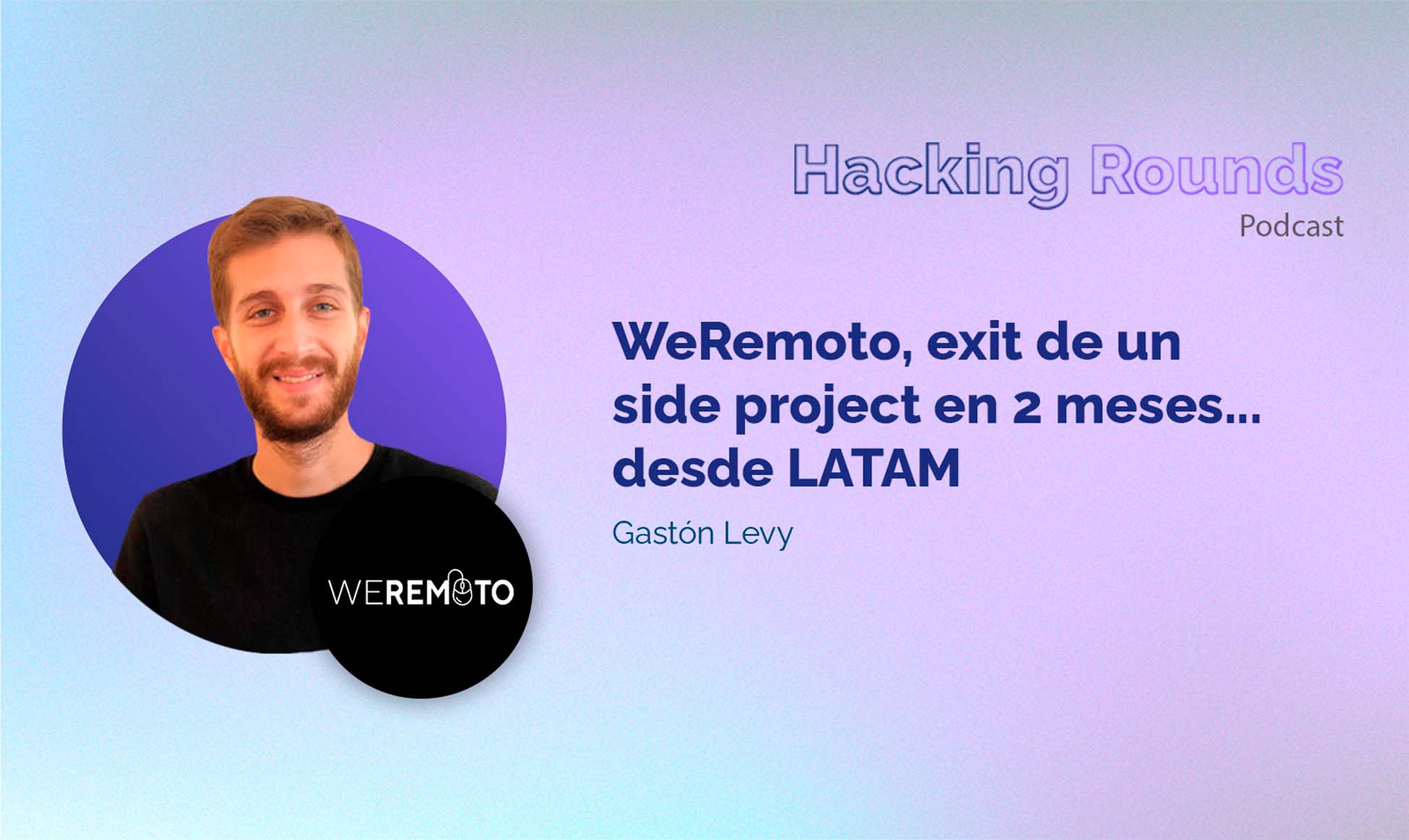
In conversation with
Gastón Levy
WeRemoto
Visit guest websiteOriginal recording. Written overview in English.
Listen on Spotify
Open in SpotifyWatch the conversation
Open in YouTubeGastón Levy tells us in this interview what it’s like to build and sell a side project from LATAM, and how to hack an investment round through bootstrapping. In this episode, we discuss:
- The problems and challenges of building global companies as a non-technical founder, scaling a marketing agency’s operations, and the rise of no-code and building in public.
- The pivots needed to make a side project sustainable, and the key points to consider when planning to sell in the short term, and
- The importance of building and growing a community for businesses, especially startups.
Highlights
Benefits of No-Code
If you’ve never used no-code tools to launch a product, you’re probably wondering: Why use no-code? Based on Gastón’s experience, no-code has the following benefits:
- You don’t need to raise funding to launch
- You don’t need a technical co-founder
- A short time to launch and test monetization
Indicators of value for a customer
A customer will be willing to pay for your product when it meets one of the following criteria for completing a task:
- Reduced time
- Reduced cost
- Increased revenue
How did you monetize the product?
Through newsletter sponsorships.
“We tried charging companies to post jobs, but it was very difficult in LATAM. Sponsoring the newsletter was more valuable to companies than posting jobs on WeRemoto. You shouldn’t get attached to 1 monetization idea. If something we create isn’t the core business but generates revenue, we should make the most of it.”
What was the sales process like?
- WeRemoto found acquire.com (formerly MicroAcquire), a place where it could post information about WeRemoto, and 10 interested parties quickly appeared.
- In the initial conversations, they narrowed the list down to 3 people after ruling out the other 7 due to lack of interest, scams, or a lack of alignment on the vision.
- Ultimately, they chose the buyer because of their alignment with the product vision and their support for the region.
“It took 2 months from when I listed it to when I transferred the domain.”
Twitter accounts to follow
Gastón recommended the following Twitter accounts as people to follow for insights into building startups and launching products: