Venture Capital in Chile Leads Latin America in Efficiency and Growth in 2025
Venture capital in Chile is growing in 2025, leading Latin America in efficiency and strengthening its startup ecosystem.

Venture capital in Chile is attracting increasing attention across Latin America as venture-backed startups begin transforming industries through technologies such as artificial intelligence, payment automation, and talent management platforms. Companies raising capital today often become partners, suppliers, or competitors of established organizations within a few years.
Chile’s Venture Capital Ecosystem Reaches a New Milestone
In 2025, Chile attracted US$249 million in venture capital across 53 rounds, representing growth of 57% compared with the US$159 million invested in 2024. According to the VC Efficiency Index (VEI), published by Cuantico VP in the Latin America Venture Capital Report 2026, Chile ranked as Latin America’s most efficient venture capital ecosystem, with a score of 40.2, ahead of Uruguay (39.1) and Brazil (38.2).
The index evaluates venture capital ecosystems using three metrics: venture capital as a percentage of GDP (intensity), investment per capita (density), and the number of rounds per million inhabitants (breadth). Chile scored more than 38 points in all three categories, making it the only country in the region with such a balanced performance.
Venture Capital Trends in Latin America
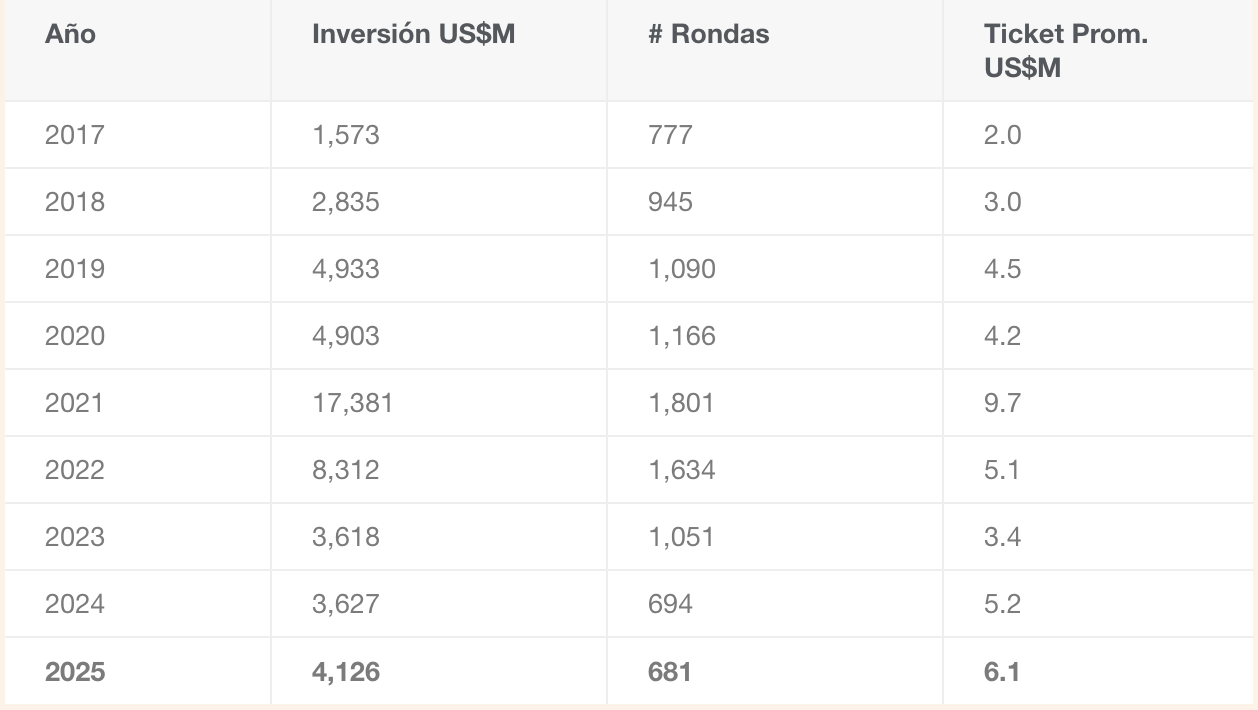
Across the region, venture capital reached US$4,126 million across 681 rounds in 2025, up 14% from US$3,627 million in 2024, although the number of rounds dipped slightly from 694 to 681. As a result, the average deal size rose from US$5.2 million to US$6.1 million.
“The recovery in 2025 is selective rather than broad-based,” said José Kont, Executive Director of Cuantico VP, noting that investors are prioritizing startups with proven business models and regional scalability.
The venture capital cycle in Latin America peaked in 2021, with US$17,381 million invested, followed by a correction between 2022 and 2024 that significantly reduced funding. The increase recorded in 2025 marks the first year of sustained recovery since that downturn.
The Startups Driving Chile’s Ecosystem
Several Chilean startups raised notable rounds during 2025, particularly in fintech, SaaS, and HR tech.
Some of the most notable deals include:
- Toku — US$48M (Series A extension), backed by Oak HC/FT, Gradient (Google), F-Prime, and Y Combinator
- AgendaPro — US$35M (growth round), backed by Riverwood Capital and Kayyak Ventures
- Vambe — US$14M (Series A), backed by Monashees, Cathay Pacific, and Nazca
- Rankmi — US$11M (Series A+), backed by Kayyak Ventures
- diio — US$2.5M (Seed), backed by Base10 Partners and Fen Ventures
- Creditú — US$2.5M (Seed), backed by ALIVE Ventures
These companies operate in several Latin American markets, reflecting a growing trend of early regional expansion among Chilean startups.
Infrastructure Supporting the Ecosystem
Chile’s venture capital ecosystem is supported by public policy, private capital, and startup infrastructure.
The public development agency CORFO has played a central role by providing US$1,069 million in credit lines to venture capital funds since 1998, helping generate US$878 million in direct investment in startups. Meanwhile, Start-Up Chile, launched in 2010, has accelerated more than 3,000 startups from over 80 countries.
The ecosystem also includes 66 venture capital funds, which have participated in nearly 1,940 investment rounds across more than 580 companies, according to Tracxn.
Key Sectors and Outlook for 2026
Chile has built strengths in sectors such as fintech, foodtech, SaaS, HR tech, agtech, and renewable energy technologies. Companies such as NotCo, Toku, AgendaPro, and Rankmi reflect the diversity of innovation emerging from the ecosystem.
Looking ahead to 2026, several trends are expected to shape the next phase of growth. Artificial intelligence is becoming central to startup products, as seen at companies such as Vambe and diio, while regulatory discussions could open the door for institutional investors, such as pension funds, to participate in venture capital.
At the same time, initiatives such as ScaleX, created by the Santiago Stock Exchange and CORFO, aim to expand exit opportunities and startups’ access to capital markets.
Taken together, these developments position venture capital in Chile as one of Latin America’s most dynamic innovation ecosystems, combining strong institutional support with a growing pipeline of globally minded startups.