Naran raises US$10 million and prepares to enter new markets
Naran raises US$10 million in equity and debt to expand its fleets, develop fintech products and enter new markets.

Naran raised US$10 million in equity and debt from Landel to accelerate the expansion of its mobility model based on rent-to-own, expand its fleets in emerging markets and develop new fintech products.
The fintech was founded in 2025 by Bayaskhalan Alexeev and Alexander Gubarev, both former Yango executives who helped launch ride-hailing operations in Latin America and Africa.
Capital to expand fleets and enter new markets
The new funding will allow Naran to expand its operations in Colombia, Peru, Senegal and Côte d’Ivoire, while preparing to enter new markets, including MENA.
The company will also allocate some of the capital to developing new fintech products, with the aim of complementing its current vehicle financing and management model.
One of the next steps in its expansion will be Paraguay, where Naran is preparing to enter in September 2026.
The company aims to operate in 10 countries by 2030, with a projected fleet of 10,000 cars and 20,000 motorcycles.
A rent-to-own model for drivers
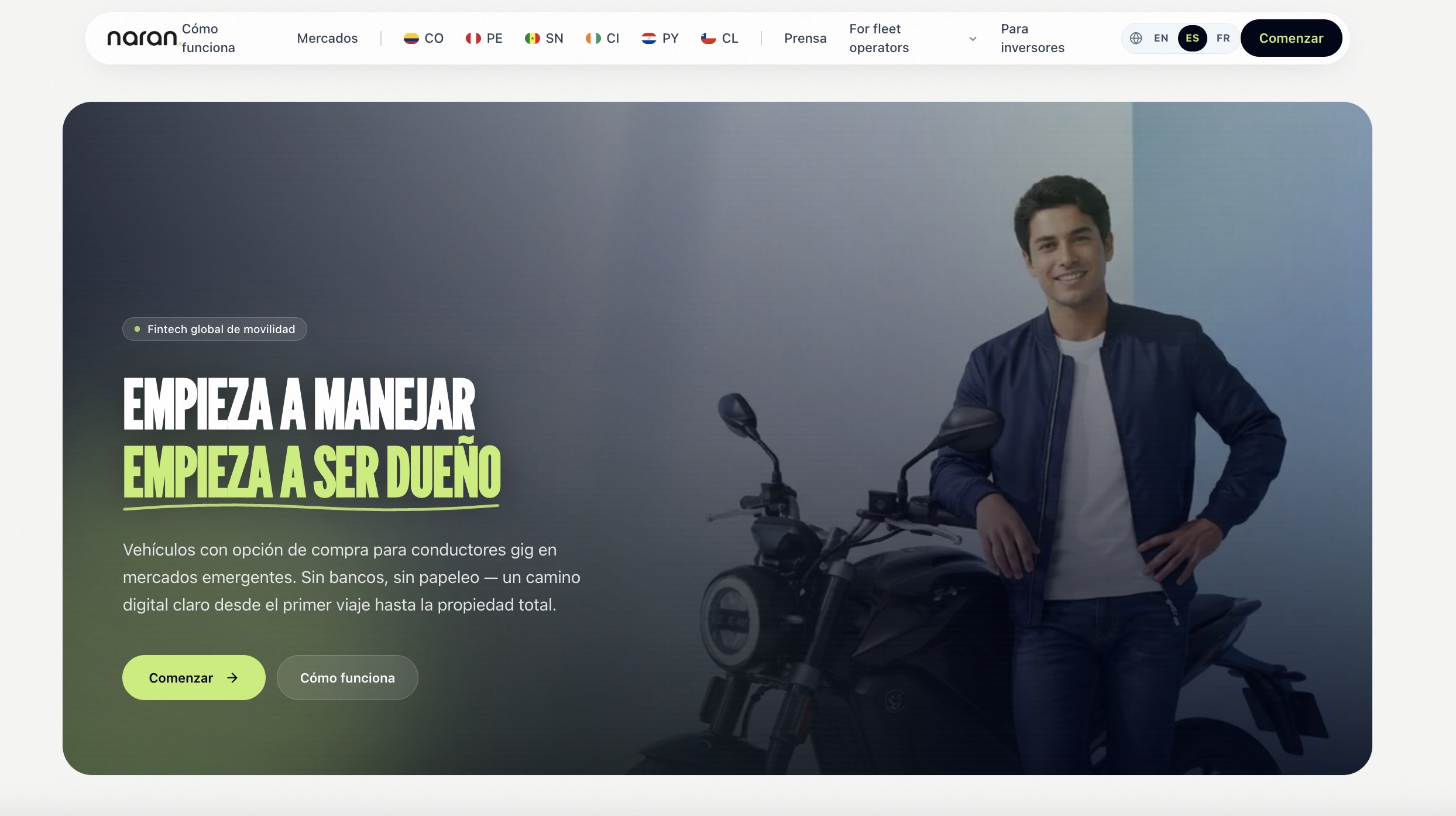
Naran operates on a rent-to-own model, acquiring vehicles directly from manufacturers and then providing them to independent drivers.
Contracts run for between 12 and 60 months and are used alongside mobility platforms such as Yango and inDrive.
The model aims to address a financing gap affecting drivers on mobility platforms in emerging markets, particularly those with irregular incomes or limited credit histories.
“We are addressing a critical gap in emerging markets, where mobility platform drivers cannot access traditional bank loans because of irregular incomes or limited credit histories,” said Bayaskhalan Alexeev, CEO and co-founder of Naran.
Proprietary technology for fleet management
In addition to financing vehicles, Naran has developed its own technology infrastructure to manage its fleets across different markets.
The system allows the company to register drivers, schedule payments and monitor vehicle utilization. It also includes telematics and maintenance tools.
The company now aims to expand the reach of this infrastructure and also turn it into a solution for third-party fleet operators.
To do this, Naran plans to offer software as a service (SaaS), asset-backed financing and, where appropriate, acquire fleet operators.
This would allow the operators themselves to become customers of the company.
Expansion focused on Latin America and Africa

Naran’s strategy focuses on two regions with significant mobility services activity: Latin America and Africa.
Latin America is among the world’s most active markets for ride-hailing. São Paulo and Mexico City, for example, have the highest volumes of Uber rides globally.
Africa also presents an opportunity for the model due to high levels of informal employment. In sub-Saharan Africa, about 88% of employment is informal, making it difficult for drivers to access the financing they need to purchase vehicles.
At the same time, demand for mobility services continues to grow, and Côte d’Ivoire is among the markets where Naran sees an opportunity to develop its model.
A goal of 30,000 income opportunities
The company aims to scale its model regionally and create 30,000 income opportunities in emerging markets.
To achieve this goal, Naran will combine financing, fleet management technology and new fintech products.
Its plan is to reach 2030 by establishing a presence in 10 countries and operating a fleet of 10,000 cars and 20,000 motorcycles, while continuing to expand the options available to drivers and fleet operators in markets where access to traditional financing remains limited.