Mexico Leads Latin America’s Mega-Rounds in the First Half of 2026
Mexico leads Latin America’s largest VC rounds in 2026, with nine of the 10 largest deals concentrated in Mexico and Brazil.

Latin America’s venture capital market is entering a new era of mega-rounds, with startups raising hundreds of millions of dollars in individual deals. Cuantico VP data shows that Mexico is at the center of this shift, with six of the region’s 10 largest VC rounds over the past 12 months, while Mexico and Brazil together account for nine of the 10 largest deals.
The ranking reveals a clear concentration of capital in fintech and software companies spanning payments, consumer credit, digital banking, ERP, and AI-powered legaltech. Argentina is the only country outside the Mexico-Brazil duopoly represented in the top 10, through Ualá.
The figures reflect both the growing maturity of Latin America’s venture capital ecosystem and increasing inequality in access to large-scale capital across the region.
Latin America’s Largest VC Rounds
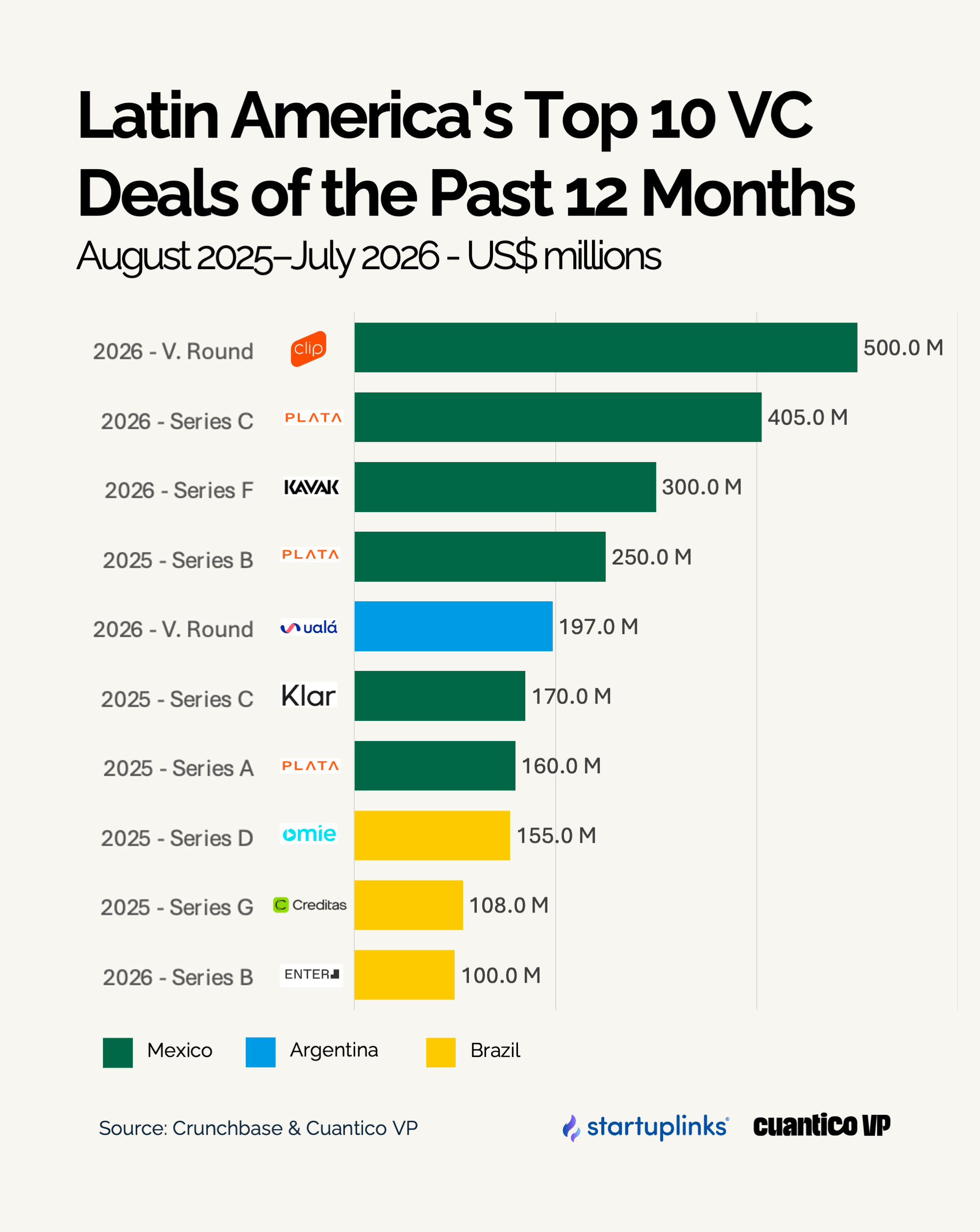
The past 12 months have produced a series of funding rounds that have significantly raised the ceiling for venture capital in Latin America. According to Cuantico VP, the 10 largest deals were:
1. Clip — US$500M Venture Round, Mexico
Clip takes first place with a US$500 million venture round in 2026. The deal reinforces the company’s position as one of the region’s leading payments enablers and raises the bar for what a Mexican fintech can achieve at later stages.
2. Plata — US$405M Series C, Mexico
Plata ranks second with a US$405 million Series C in 2026, focused on credit and rewards. The round came just a few months after its Series B and positions Plata among the Mexican fintech sector’s most aggressive growth stories.
3. Kavak — US$300M Series F, Mexico
Used-car platform Kavak raised US$300 million in a Series F in 2026, maintaining its ability to attract capital at a global scale. The round confirms that regional champions remain on growth investors’ radar.
4. Plata — US$250M Series B, Mexico
Before its US$405 million Series C, Plata had already raised US$250 million in a Series B in 2025. On its own, the round would be unusually large for the region; viewed alongside its subsequent financing, it marks the start of an unprecedented capital build-up for a local startup.
5. Ualá — US$197M Venture Round, Argentina
Ualá’s US$197 million venture round in 2026 makes Argentina the only country outside Mexico and Brazil represented in the top 10. The deal reinforces Ualá’s position as one of the Southern Cone’s leading digital banks and shows that Argentina can still produce deals at a continental scale.
6. Klar — US$170M Series C, Mexico
Mexican fintech Klar raised US$170 million in a Series C in 2025, focused on consumer credit and cards. The deal reinforces the growing role of a small group of well-funded players in Mexico’s emerging retail banking market.
7. Plata — US$160M Series A, Mexico
Plata appears for the third time in the ranking with a US$160 million Series A in 2025. The round would stand out as an outlier on its own, but as part of Plata’s A-B-C funding sequence, it represents the first step in a capital trajectory that is redefining funding scales for Latin America’s early- and growth-stage companies.
8. Omie — US$155M Series D, Brazil
The first Brazilian company in the ranking is Omie, which raised US$155 million in a Series D in 2025. The company develops ERP and CRM software for small and medium-sized businesses, showing that B2B SaaS can also attract nine-figure funding rounds in Latin America.
9. Creditas — US$108M Series G, Brazil
Creditas raised US$108 million in a Series G in 2025, focused on secured credit and consumer financing. The deal reinforces Cuantico VP’s findings that lending fintechs remain one of the region’s biggest magnets for large funds.
10. Enter — US$100M Series B, Brazil
Brazilian AI-powered legaltech Enter rounds out the ranking with a US$100 million Series B in 2026. The deal highlights how AI applied to specific verticals is also beginning to attract large checks, bringing the company into the big leagues of financing before it reaches the traditional growth stage.
Mexico and Brazil Account for the Largest Deals
The geographic distribution of the 10 largest rounds makes the concentration of venture capital especially clear.
Mexico accounts for six of the 10 largest deals, including Clip, Plata’s three rounds, Klar, and Kavak. Brazil contributes three deals through Omie, Creditas, and Enter. Argentina accounts for the remaining deal with Ualá.
As a result, nine of the 10 largest venture capital rounds over the past 12 months were concentrated in Mexico and Brazil.
Other active Latin American ecosystems, including Colombia, Chile, and Peru, do not appear among the region’s largest checks.
This concentration is consistent with Cuantico VP’s broader findings, which show that Brazil and Mexico accounted for 78.5% of all venture capital deployed in the region in 2025. The Latin America VC Report 2026 and its preliminary findings help put this concentration into perspective.
The top 10 thus offers a direct illustration of where large-scale venture capital is currently accumulating in Latin America. The companies receiving these checks are increasingly positioned as potential regional champions, while startups in other ecosystems continue to compete for smaller rounds.
Fintech Continues to Attract the Largest Checks
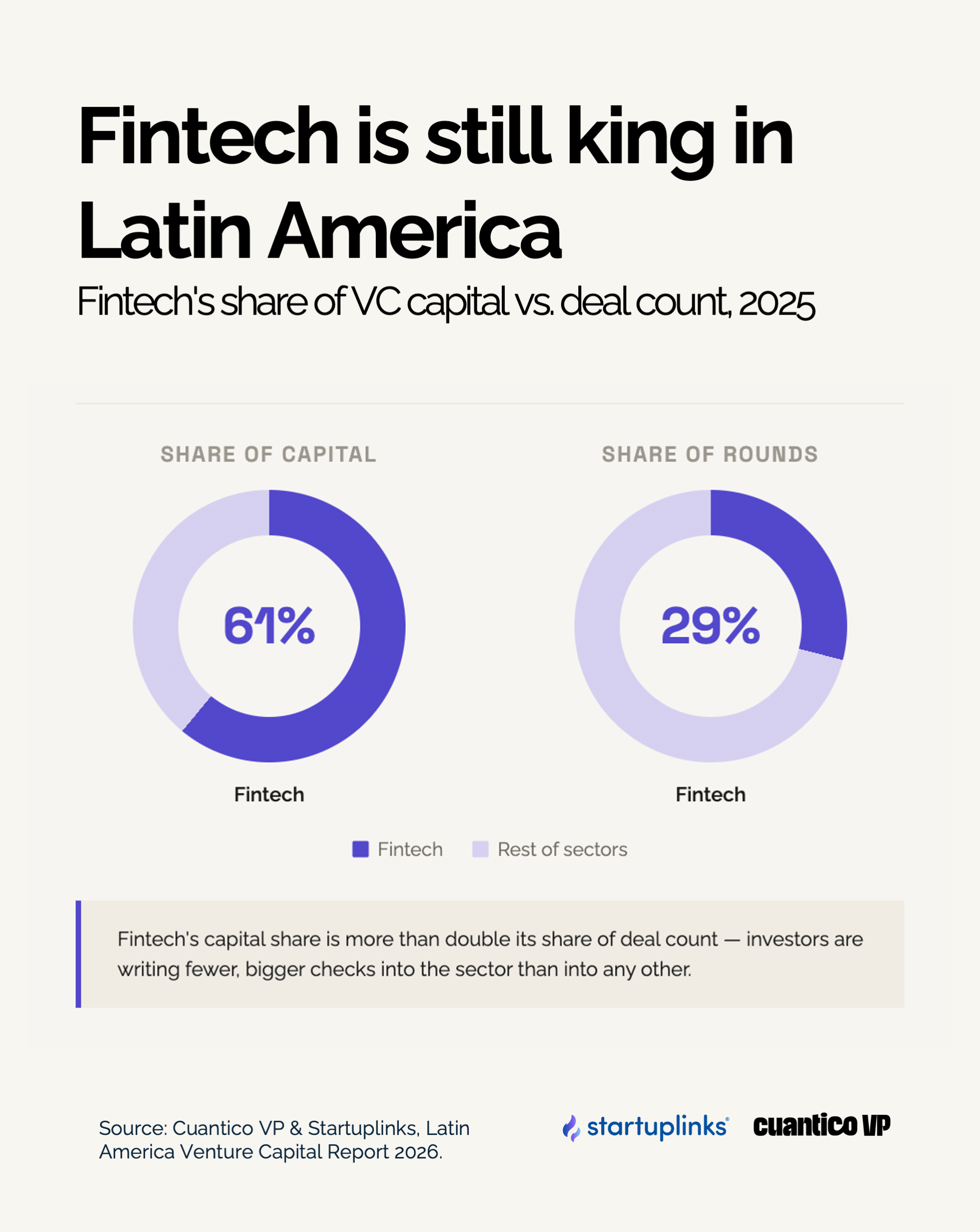
The list reinforces another key point made in Cuantico VP’s reports: fintech captures 61% of regional capital in just 29% of rounds . In the top 10, that translates into:
- Payments (Clip), cards and consumer credit (Plata, Klar, Ualá), secured credit (Creditas), and BNPL/digital commerce.
- Only three companies outside pure fintech—Kavak (cars), Omie (ERP/CRM), and Enter (AI legaltech)—make the list, and even they have a strong financial or software infrastructure component.
In practice, this means Latam’s largest checks are still coming from financial services and related software. Those building the rails for money, credit, or bankable payments are playing in a league of deal sizes that other sectors have yet to reach.
Record-Breaking Rounds and the Risk of the Anchoring Effect
The rapid growth in deal sizes is also creating new benchmarks for founders and investors.
Jose Kont, a Partner at Cuantico VP, points to what he describes as an “anchoring effect” in fundraising conversations:
“These record-breaking rounds are starting to be used as benchmarks in fundraising meetings, pitch decks, and valuation negotiations. When founders cite a US$150M Series A or a US$400M Series C, the risk is that they try to replicate the price without replicating the traction.”
This concern arises as valuations have also risen considerably. According to Cuantico VP, the region’s median pre-money valuation for a Series A increased from US$30 million in 2025 to US$150 million in 2026, a fivefold increase in a single year.
At the same time, the total number of rounds fell from 694 to 681.
The combination points to a market where capital is getting larger, but also more concentrated: fewer rounds are closing, while a smaller group of companies is attracting increasingly large amounts of funding.
A more mature, but also more unequal, venture capital market
The 10 largest rounds of the past 12 months capture both sides of the current venture capital story in Latin America.
On the one hand, the region is seeing funding rounds of US$500 million, US$405 million and US$300 million, showing that its leading startups can attract capital at a scale that would have seemed unusual in the region just a few years ago.
On the other hand, these mega-rounds are concentrated among a limited group of companies and geographies. Mexico and Brazil account for nine of the 10 largest rounds, while fintech dominates the ranking.
The result is a venture capital market increasingly capable of producing regional champions and mega-rounds, but where access to that level of capital remains unequal across Latin America.
As Cuantico VP’s data shows, the region is not only raising more capital at the top end of the market. It is raising larger amounts through fewer deals, with capital becoming increasingly concentrated.