Doroth raises US$4.5 million to scale its lab-on-a-chip technology in Brazil
Doroth raises US$4.5 million to scale its lab-on-a-chip technology, build a microfluidic chip plant, and expand molecular diagnostics.

Doroth, a Brazilian deeptech specializing in lab-on-a-chip platforms for molecular diagnostics, raised R$23 million, equivalent to approximately US$4.51 million, in a round led by Loccus, a Brazilian biotechnology, instrumentation, and molecular diagnostics company. The deal combines private capital with funding from Finep and Fapesp and will allow the startup to move from a stage focused on research and validation toward industrial-scale production.
Doroth and Loccus combine capabilities to bring the technology to market
The deal stems from the complementary capabilities of the two companies. While Loccus brings experience in production, infrastructure, innovation, and industrial development focused on human and animal health, Doroth contributes scientific expertise and the ability to develop projects and secure funding.
For Eduardo Araújo, Loccus CEO, the partnership aims to address one of Doroth’s main challenges: bringing its technological developments to production scale.
“We have production and innovation capabilities, with a strong focus on human and animal health. Doroth, in turn, has an immense body of scientific knowledge, because the people who work there are outstanding researchers, but it lacks the production capacity to scale its inventions.”
Through this integration, Doroth will focus on product development and securing funding, while Loccus will contribute manufacturing, infrastructure, scientific expertise, industrial capacity, regulatory support, and the integration of technologies already in its portfolio.
The goal is to shorten the path from technology development to market entry, as well as accelerate the creation of new tests and expand production of equipment, chips, and reagents.
A microfluidic chip plant with capacity to produce up to 4 million units a year
One of the main uses of the investment will be to build what Doroth describes as Latin America’s first microfluidic chip manufacturing facility.
According to Rodrigo Gurdos, Doroth’s founder and director of New Business, the plant will have the capacity to produce up to 4 million chips a year.
The facility will be fully automated and use precision robots to handle lyophilized beads, spheres containing dehydrated reagents used in tests. It will also have self-sufficient production of proprietary enzymes for qPCR, LAMP, and Extreme PCR, techniques used to amplify genetic material in molecular diagnostics.
The facility will also include lyobead production and a line equipped with delta robots to assemble the chips without human handling.
The installed capacity is designed to serve Doroth’s first phase of expansion in the agricultural market. Products that the new plant will enable the company to develop include Extreme PCR, an enzyme that, according to Gurdos, can deliver results in less than five minutes.
What does Doroth do?
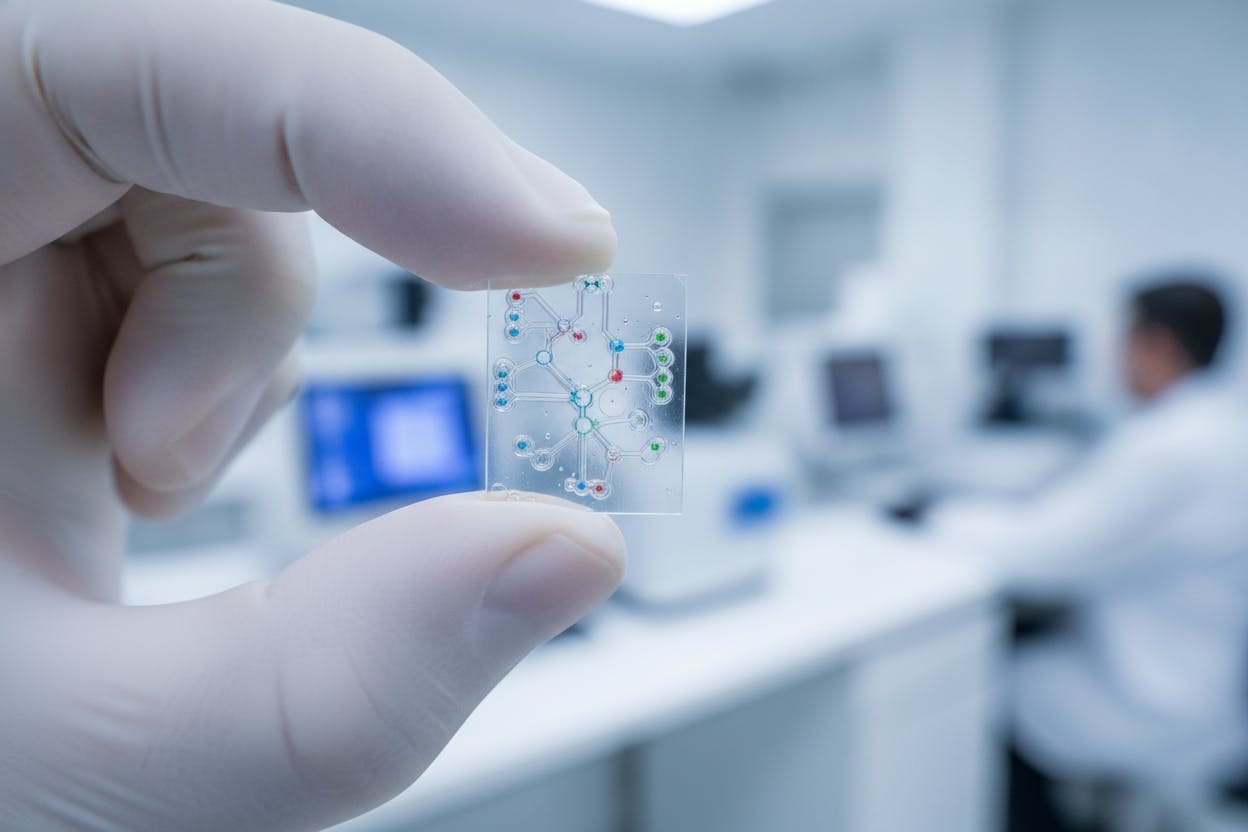
Founded in 2019 and headquartered in Piracicaba, São Paulo, Doroth brings together expertise in molecular biology, microfluidics, engineering, electronics, optics, automation, and software.
Its platforms integrate various processes that currently rely on a laboratory—such as sample preparation, genetic material extraction, amplification, and results interpretation—into compact, automated equipment.
The solutions can be used to identify pathogens, microorganisms, genetically modified organisms, and resistance genes in samples such as leaves, seeds, grains, milk, and meat.
The technology has applications across different stages of the agribusiness value chain, from plant and animal health to raw material quality control, traceability, and agro-industrial processes.
The platform can also detect viruses, bacteria, and other infectious agents in insect vectors, such as the corn leafhopper, which is relevant to agricultural health, and Aedes aegypti, which is associated with public health.
From research to industrial-scale production
Doroth is already developing projects with major companies in the agricultural sector. For the company, the partnership with Loccus marks a shift from a stage centered primarily on research and validation to a phase of industrial-scale production.
The integration also aims to strengthen a domestic technology supply chain spanning enzymes and molecular assays through to sensors, automated instruments, and microfluidic consumables.
The funds raised will go toward expanding the startup’s research, development, and production capabilities, including the establishment of a microfluidic chip plant with integrated proprietary reagents.
The goal is to turn technologies developed entirely in Brazil into products manufactured at scale, reducing dependence on imported reagents and sensors and expanding access to decentralized molecular diagnostic solutions for agribusiness.
“By bringing the companies together, we’re creating an unbeatable team. We have the best creative minds on both sides, a production process that serves both companies, and distribution channels that Doroth will use,” said Eduardo Araújo.
Loccus strengthens its open innovation strategy
The deal also expands Loccus’s growth strategy through open innovation, venture building, and Corporate Venture Capital (CVC) initiatives, particularly through its Bios and Nanos programs.
Since these initiatives were launched, more than 20 deeptechs have been selected to join the company’s ecosystem.
Bios is aimed at startups in biotechnology, health, agribusiness, molecular diagnostics, and the bioeconomy. Nanos, meanwhile, focuses on nanotechnology, advanced materials, and highly complex technologies, connecting startups, researchers, scientific institutions, and industry.
The round was supported by MOA Ventures, which advised Loccus on structuring the investment and also coordinates the Bios and Nanos programs.
Doroth was advised on the deal by S4 Consultoria, which acted as exclusive financial advisor on the structuring, negotiation, and closing of the transaction.