A5X raises US$70 million in Series D to compete with B3 in Brazil
A5X raises US$70 million in Series D, reaching a valuation of US$525 million as it prepares to enter Brazil’s derivatives market.

A5X, the Brazilian startup developing a derivatives exchange to compete with B3, announced on 14 September 2026 a Series D round of approximately US$70 million, equivalent to R$360 million. The deal brought the company’s post-money valuation to nearly US$525 million, or about R$2.7 billion.
The round brings in Morgan Stanley, Goldman Sachs, and Latin American venture capital fund Kaszek as new investors, alongside several existing shareholders.
Morgan Stanley, Goldman Sachs, and Kaszek join the round
Investors participating again include market makers IMC, Jump Trading, Optiver, and XTX Markets, as well as ABN AMRO Clearing. Broker XP exercised a purchase option during the round, while Itaú’s brokerage unit has remained an investor since 2024.
With this new capital injection, A5X has raised more than US$143 million, approximately R$730 million, across four funding rounds since it was founded in 2023.
The participation of Morgan Stanley and Goldman Sachs also stands out because of the institutions’ potential ties to the future platform, in addition to their role as investors. The model is reminiscent of the one used in the United States to promote new market infrastructures such as Members Exchange and BATS.
What is A5X, and what is it seeking to build?
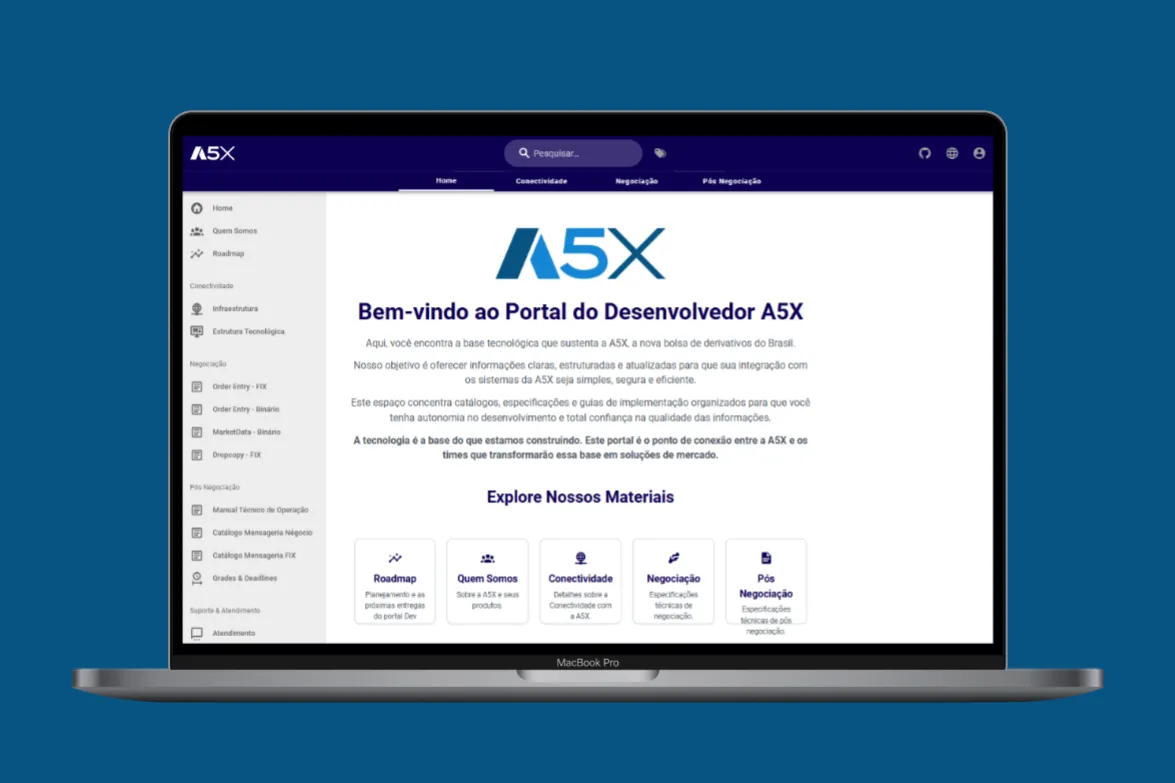
A5X was founded by Carlos Ferreira Filho, the company’s CEO, and co-founders Karel Luketic, both former XP executives; Nilson Monteiro, who developed brokerage firm Link and later founded Ideal, acquired by Itaú in 2022; and capital markets lawyer Julian Chediak.
The company plans to list futures and options on stock indexes, individual stocks, currencies, interest rates, and digital assets.
Unlike a model based on B3, A5X intends to operate its own central counterparty rather than clearing trades through B3. The startup has an agreement with London Stock Exchange Group for its technology.
A5X launch delayed until 2027
Although the company had previously said it expected to begin operations in late 2026, it now expects to launch in the second quarter of 2027.
Under the updated timeline, connection tests with regulators are scheduled for October and November 2026. However, A5X is still waiting to obtain the required approvals from Brazil’s securities commission and central bank.
The revised timeline means the company will have to wait an additional two to three quarters before its first contracts can begin trading.
B3 dominates Brazil’s listed-products market
For more than a decade, B3 has been the sole reference platform in Brazil’s listed markets. A5X is specifically seeking to compete in the product segment that accounts for a significant share of the Brazilian exchange’s revenue.
According to a Goldman Sachs note cited by Money Times, listed products accounted for 32% of B3’s revenue in 2023. Of that share, approximately 8% came from equities and 24% from fixed-income, foreign-exchange, and commodity contracts.
This revenue stream recorded a compound annual growth rate of 16% between 2016 and 2023. At the same time, average fees per contract fell by around 4% annually over the same period, a trend that a new competitor could accelerate.
Competition also poses challenges for A5X
Goldman Sachs also pointed to limits on the competitive threat. According to its analysis, A5X would need to create its own contracts, rather than simply replicate B3’s products, to have a significant impact on the existing platform.
The firm maintained a neutral rating on B3, in part because it considered the competitive risk to be already reflected in the stock’s discount.
In addition, A5X is not the only project seeking to open up competition in this market. Base Exchange has also made progress on a similar proposal.
What sets this new round apart is the profile of the investors. Morgan Stanley and Goldman Sachs are not only providing capital to a new platform, but could also become users of it. This model follows the precedent set by Members Exchange and BATS in the United States.
“Competition is expected to foster innovation and technology advancement, and lead to better pricing.” — Karel Luketic, co-founder of A5X
A5X’s expansion also has implications for the international market
For the United States, the development of A5X represents an expansion of a market-structure model that has been developing for two decades in equities and derivatives trading across multiple platforms.
Firms with experience in fragmented markets, including high-frequency market makers and clearing entities, are among those funding A5X. Jump Trading, Optiver, XTX Markets, and ABN AMRO Clearing could benefit from a second Brazilian platform seeking to attract volume by competing on price.
For Morgan Stanley and Goldman Sachs, the investment represents both a financial bet and a way to hedge their execution costs in one of the major emerging derivatives markets.
Hedging costs are a central issue for Brazil
In Brazil, one of the main issues at stake is the cost of hedging. Dollar and interest-rate futures on B3 are used by Brazilian companies, banks, and foreign investors to manage their exposure to currencies and interest rates.
A second platform capable of competing could put pressure on fees. However, there is also the challenge of splitting liquidity, a key factor in making a derivatives contract viable.
The arrival of new infrastructure also raises a question for regulators: whether having two central counterparties in a market of this size strengthens the system or fragments the available collateral.
The launch delay also matters
Beyond the US$70 million raised in the Series D, the launch timeline will be an important factor for A5X.
Moving from an expected launch in late 2026 to a planned opening in the second quarter of 2027 gives B3 an additional two to three quarters to adjust its prices and consolidate its customer base before its new competitor’s first contracts begin trading.