3 Reports Everyone Interested in Venture Capital Should Read This Year
Less euphoria, more discipline: the 3 essential reports from 2026 reveal the structural shift in venture capital across Latin America.

There are years when the venture capital industry in Latin America moves more capital than opinions, and years when the opposite is true. 2026 is, fortunately, one of the former. After a correction cycle that began with the collapse of the 2021 peak, when the region saw US$17.4 billion move in a single year, the ecosystem is showing clear signs of maturity: more discipline, larger checks, and something that seemed like a dream just 18 months ago: real exits.
But understanding where the industry is headed takes more than following the Twitter thread or reading fund press releases. It requires diving into the data, conceptual frameworks, and academic evidence that now, for the first time in the history of the Latin American ecosystem, exist in sufficient quantity and quality. This year, three reports stand out from the noise. They are not the only ones worth reading, but together they offer the most complete picture of what is happening, why it is happening, and what comes next. They are the reports from Cuantico VP, the World Economic Forum, and IE University.
Latin America VC Report 2026 — Cuantico VP & Startuplinks: The ecosystem barometer
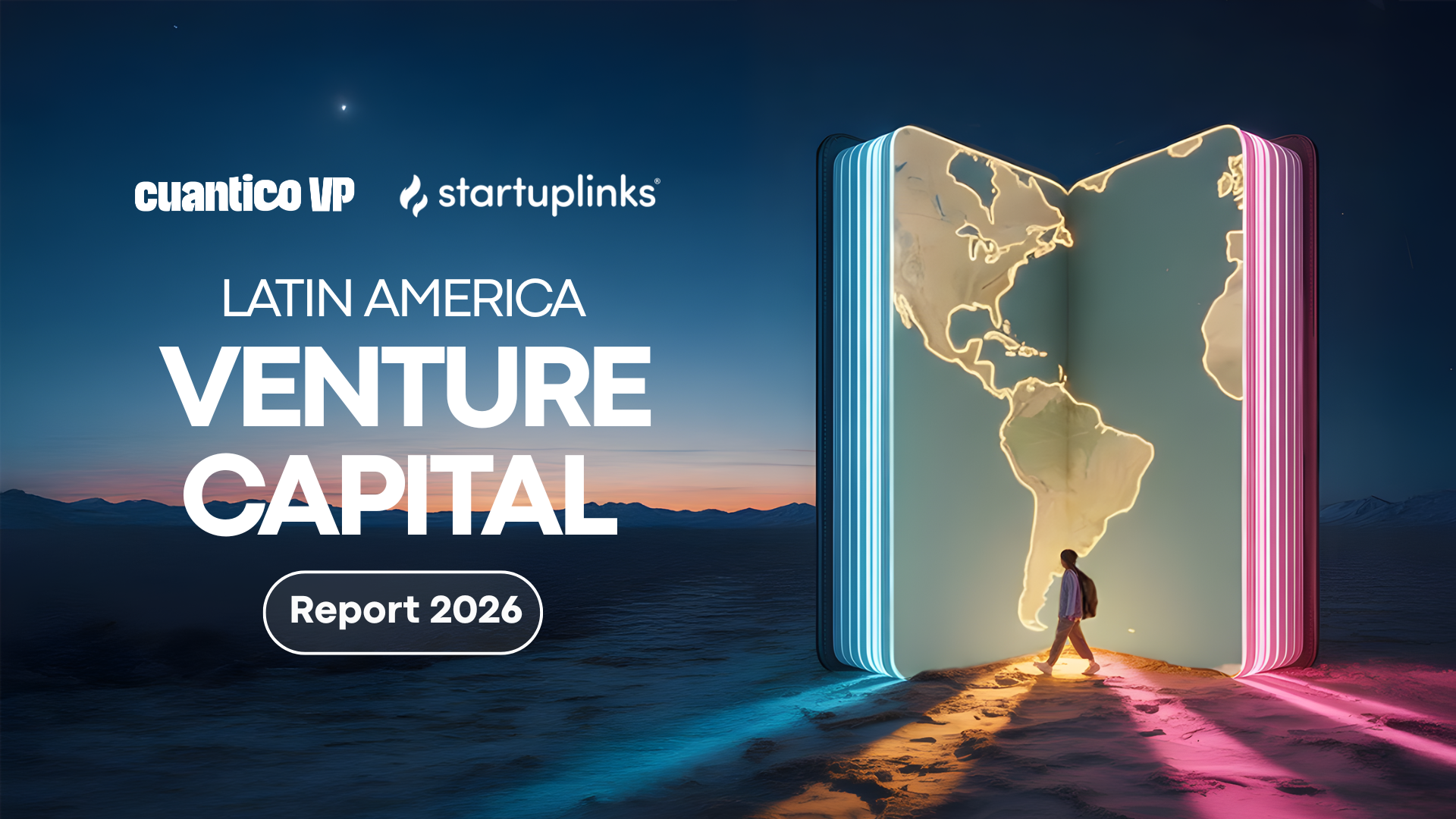
If one document has become essential reading for anyone who wants to speak with authority about venture capital in Latin America, this is it. Now in its fourth annual edition, the Latin America VC Report by Cuantico VP, in collaboration with Startuplinks, combines hard data with two perception indexes (one for investors and another for founders) and a new VC Efficiency Index, making it more than an annual roundup of funding rounds: it is a snapshot of the ecosystem’s mood.
The numbers behind the narrative
The headline for 2026 is simple but powerful: after three consecutive years of contraction, venture capital in Latin America bounced back. In 2025, US$4.126 billion was invested across 681 rounds, a 13.8% increase from the US$3.627 billion in 2024. But there is a catch, and the report does not hide it: the number of rounds fell 1.9% to its lowest level since 2017. In other words, it is not that more startups are getting funded; the checks are larger.
The average ticket rose from US$5.2M to US$6.1M per round. Brazil and Mexico accounted for 78.5% of all capital deployed in the region, with Brazil attracting US$2.032 billion and Mexico US$980 million across 86 rounds, underscoring that geographic concentration remains one of the ecosystem’s structural challenges.
The story no one expected: exits
The figure that really changed the conversation in 2026 was not investment: it was exits. Exits by VC-backed startups reached US$4.9 billion in 2025, a 172% increase over the previous year. Two transactions dominated the landscape: Prosus’s acquisition of Despegar for US$1.7 billion and Securitize’s US$1.25 billion SPAC exit. Together, they accounted for almost half of the total value of exits. Including undisclosed private equity transactions and secondary sales, the report estimates that actual market liquidity may have exceeded US$6 billion.
Fintech: still king, but facing new pressures
The fintech sector captured 61% of the region’s total capital with just 29% of the deals. Rounds for companies like Plata and Klar in Mexico confirm that the largest checks are still going to financial services. Chile, Uruguay, and Brazil make up the region’s Tier 1, combining high investment intensity, VC per capita, and deal activity.
The report closes with a phrase that sums up the moment: “less euphoria, more discipline; fewer rounds, larger checks; less focus on headlines, more focus on returns”. For any industry professional, that phrase should serve as a compass for the next 24 months. Access the report.
The Future of Venture Capital: Unlocking Liquidity and Growth — World Economic Forum & Stanford: The global diagnosis that explains the bigger picture
If the Cuantico VP report tells you what is happening in LATAM, the World Economic Forum and Stanford report tells you why the VC world is the way it is, and what macro-level rules of the game shape the conditions in which the region operates.
Published in May 2026, this document is the result of two years of work with some of the most prominent voices in the global industry, and its central diagnosis is as clear as it is uncomfortable: the venture capital model is under unprecedented structural pressure.
The problem: the money isn’t coming back
For decades, VC operated as a virtuous cycle. Funds invested, startups grew, went public or were acquired, and distributions or “exits” funded the next generation of startups. That cycle is stalling. Today, approximately 1,920 unicorns remain private, with valuations exceeding US$7.3 trillion, and an estimated US$3 trillion in unrealized value remains trapped on VC fund balance sheets.
Distribution figures are even more revealing: funds that historically returned 20% of their value to investors between years 5 and 10 of their life now return just 10% or 12%. Among vintage 2021 funds, three-quarters had returned less than 25% of committed capital to their investors. The average time for a VC-backed startup to reach its IPO rose to 12 years in 2025.
The geography of innovation is splitting in two
One of the most relevant findings for Latin America is the analysis of the global “scale-up gap.” The report documents that while startup creation has gone global, the ability to scale them into world-leading companies remains concentrated in a few ecosystems. In North America and Asia, approximately one in 60 VC-backed startups becomes a unicorn; in Europe, one in 135; in sub-Saharan Africa, one in 330. Latin America does not appear explicitly in that statistic, which is itself telling.
The WEF also devotes a chapter to regulatory fragmentation as an “invisible tax on growth”: differences in incorporation frameworks, equity compensation, and data compliance across jurisdictions add cost and complexity at every stage of cross-border growth. For a region like LATAM, where regulations vary dramatically between Brazil, Mexico, and the rest of the region, this diagnosis hits especially close to home.
AI is changing everything, including the size of the check
The report devotes an entire chapter to how artificial intelligence is reshaping the VC economy. The central conclusion: AI captured more than 50% of global VC deal value in 2025. Just five companies raised a combined US$84 billion. “AI-native” firms can reach significant revenue milestones with much smaller teams than before, but the infrastructure they need requires capital on an industrial scale (computing, data centers, energy), attracting capital far beyond traditional VC.
The World Economic Forum’s five recommendations
The report concludes with five systemic priorities for strengthening the global ecosystem: improving secondary-market infrastructure, mobilizing institutional capital (especially pension funds), reducing cross-border regulatory friction, strengthening talent ecosystems, and enabling governments to participate strategically without intervening. Each of these recommendations has direct, practical implications for those designing innovation policy or fund strategies in Latin America. Link to access the report.
The Rise of Startups and Venture Capital in Latin America and the Caribbean: Trends and Challenges

Published in November 2025 by IE Business School’s Global Policy Center (GPC), in collaboration with the Business Council of the Alliance for Ibero-America (CEAPI) and CFA Society Spain, this is the most academic and structural of the three reports. The report combines the rigor of institutional research with a deep understanding of the Latin American ecosystem, making it both technically robust and practically relevant.
Why this report is different
While the other two reports work primarily with market data, the IE/GPC report adds a layer the others lack: an analysis of the structural market failures that startups in the region are addressing and, crucially, the public policy challenges that continue to hinder the ecosystem’s maturation.
With 38 unicorns in the region as of mid-2025 and a growing base of high-impact startups, the report argues that LATAM has gone from an opportunistic bet to a structural thesis for global capital. But that thesis comes with conditions.
The three central tensions
- First: the early-stage boom versus the late-stage desert. The region has demonstrated a notable ability to generate early-stage startups, driven by the expansion of seed and pre-seed investment. However, late-stage funding (Series B onward) remains structurally scarce. This asymmetry is not just a problem of capital supply: it signals that the ecosystem has yet to develop the trust and traction infrastructure major international funds need to commit checks of US$50 million or more in the region.
- Second: fintech dominance and sector concentration. The report identifies the “rise of fintech and e-commerce” as the main drivers of capital attraction. This is a strength, since the region has a genuine need for financial inclusion that fintech is addressing, but also a vulnerability: overdependence on a single sector makes the ecosystem fragile in the face of regulations or valuation cycles that hit that vertical specifically.
- Third: regulatory fragmentation, infrastructure gaps, and talent shortages. The report explicitly identifies these three as the structural obstacles that continue to hinder scalability. Regulatory fragmentation across countries (talent visas, equity compensation frameworks, incorporation rules, etc.) may be the least discussed, but it is one of the most costly.
The six case studies
What sets the IE/GPC report apart from other academic analyses is that it goes beyond diagnosis: it includes six in-depth case studies of startups successfully navigating these tensions. These cases make the report especially valuable for founders and investors looking not only to understand the landscape, but also to learn from those already scaling within it.
The document concludes that despite the challenges (fragmented regulation, scarce late-stage capital, and talent concentrated in a few hubs), the ecosystem shows “clear signs of maturation and long-term potential for economic and social development.” It’s the kind of conclusion that sounds like a cliché until you read the evidence behind it. Link to access the report.
The multiplier effect of reading reports from the World Economic Forum, Cuantico VP, and IE University
Individually, each of these reports is valuable. Together, they offer something more: a set of coordinates for navigating one of the most complex and promising periods the venture capital industry in Latin America has experienced.
The Cuantico VP report tells you where capital is today and how it’s moving. The WEF report gives you the global context that explains why conditions are the way they are and where they’re headed if systemic players do their part, while the IE University report gives you the structural framework for understanding what the region still needs to turn its promise into a sustained reality.
Together, they answer the question we’re all asking: Is LATAM experiencing a tactical rebound or a structural shift? The evidence suggests that, for the first time in a long while, it could be both at once.